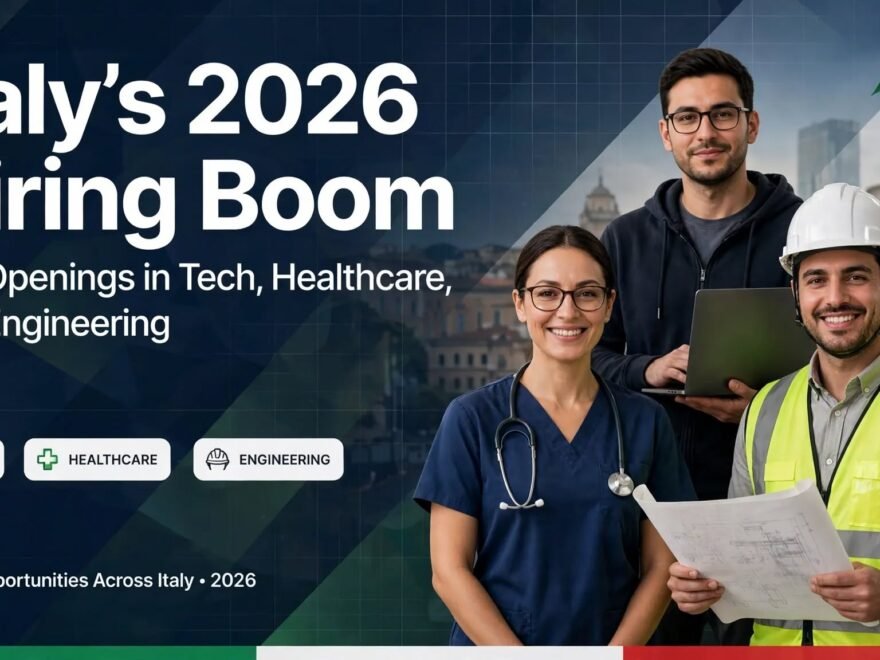
Italy’s 2026 Hiring Boom: Top Openings in Tech, Healthcare, and Engineering: Italy is undergoing a transformation in its national job market. Fueled by massive investments from the European Union’s Recovery and Resilience Facility (PNRR), combined with demographic shifts, the country is facing a demand for skilled foreign talent. Italian businesses across key sectors are actively expanding their workforces.
Whether you are a software developer seeking remote-friendly positions in Milan, a medical professional looking to join a modern hospital network, or an engineer aiming to work on infrastructure projects, Italy’s current job landscape offers diverse opportunities.
This comprehensive guide details the driving forces behind Italy’s 2026 hiring boom, highlighting in-demand job roles across Technology, Healthcare, and Engineering, alongside expected salary benchmarks and visa application procedures.
1. Why Italy is Experiencing a Hiring Boom
To understand the sudden surge in career openings across Italy, it is essential to examine the structural and economic changes taking place within the country.
Read Also: Now Hiring in Italy: 20+ High-Demand Career Opportunities for Foreigners
┌─────────────────────────────────────────────────────────────────────────────┐
│                       DRIVERS OF ITALY'S 2026 HIRING BOOM                    │
├───────────────────────────────┬─────────────────────────────────────────────┤
│ PNRR Funding ($200B+)         │ Digital & Green Transition Mega-Projects    │
├───────────────────────────────┼─────────────────────────────────────────────┤
│ Demographic Shortages         │ Accelerated Retirement & Low Domestic Supply│
├───────────────────────────────┼─────────────────────────────────────────────┤
│ Government Policy Expansion   │ Expanded Decreto Flussi & EU Blue Cards    │
└───────────────────────────────┴─────────────────────────────────────────────┘
The Impact of PNRR (National Recovery Plan)
Italy received over €190 billion in grants and loans through the EU’s NextGenerationEU initiative. These funds are designated for modernizing the national economy, with a heavy emphasis on two key pillars:
- Digital Transformation: Modernizing public administration, expanding fiber-optic infrastructure, upgrading cloud networks, and integrating artificial intelligence into industrial processes.
- Green Transition: Upgrading national railway networks, retrofitting urban infrastructure for energy efficiency, and constructing renewable energy plants.
Demographic Shifts and the Skilled Labor Shortage
Italy has one of the oldest populations in Europe. As experienced professionals reach retirement age, domestic educational institutions are not producing enough replacement graduates in technical fields. This gap has forced private enterprise and state institutions to seek qualified international talent.
Streamlined Work Permit Quotas (Decreto Flussi)
Recognizing the domestic labor shortfall, the Italian government expanded its legal immigration framework. Under the multi-year Decreto Flussi, over 160,000 non-EU work permits are allocated annually for non-seasonal skilled positions in sectors such as construction, healthcare, logistics, and telecommunications.
2. Top Job Openings in the Technology Sector
Italy’s technology ecosystem—centered primarily in Milan, Rome, Turin, and Bologna—is expanding quickly. Both international corporations and dynamic tech startups are actively competing for qualified IT talent.
                     ┌────────────────────────────────────────┐
                     │          TOP TECH ROLES (2026)         │
                     └───────────────────┬────────────────────┘
                                         │
         ┌───────────────────────────────┼───────────────────────────────┐
         │                               │                               │
┌────────┴────────┐             ┌────────┴────────┐             ┌────────┴────────┐
│  Full-Stack &   │             │   Cloud & DevOps│             │   Cybersecurity │
│  Software Devs  │             │    Engineers    │             │    Specialists  │
└─────────────────┘             └─────────────────┘             └─────────────────┘
Software Development & Full-Stack Engineering
With companies modernizing their digital infrastructure, software engineers are among the most sought-after professionals in Northern Italy.
- In-Demand Skills: JavaScript/TypeScript (Node.js, React, Angular), Java, Python, C++, Microservices Architecture, and RESTful APIs.
- Primary Hubs: Milan, Rome, Turin.
- Average Salary Range: €38,000 to €65,000 per year (Mid-Senior level).
Cloud Computing & DevOps Architecture
As enterprises migrate on-premises legacy systems to multi-cloud environments, cloud architects and DevOps professionals remain essential.
- In-Demand Skills: Amazon Web Services (AWS), Microsoft Azure, Google Cloud Platform (GCP), Docker, Kubernetes, Terraform, and CI/CD pipelines.
- Key Responsibilities: Designing scalable infrastructure, maintaining automated deployment pipelines, and ensuring system redundancy.
- Average Salary Range: €45,000 to €75,000 per year.
Cybersecurity & Information Assurance
The rapid pace of business digitization has heightened the need for robust information security practices across Italian banking, retail, and manufacturing sectors.
- In-Demand Skills: Penetration Testing, Threat Intelligence, SIEM Tools, Security Compliance (GDPR, ISO 27001), Zero-Trust Architecture.
- Average Salary Range: €42,000 to €70,000 per year.
AI, Data Analytics & Machine Learning
With businesses leveraging big data to optimize operations, demand for data engineers, data analysts, and AI developers has surged.
- In-Demand Skills: Python, R, SQL, TensorFlow, PyTorch, PowerBI, Large Language Models (LLMs), and Business Intelligence tools.
- Average Salary Range: €40,000 to €68,000 per year.
3. High-Demand Roles in Healthcare and Medicine
Italy’s National Health Service (Servizio Sanitario Nazionale or SSN), alongside private clinic networks, faces staffing shortages. Recent regulatory reforms have made it simpler for non-EU doctors and nurses to convert foreign credentials and secure practice licenses in Italy.
Specialized Physicians & Medical Specialists
Public and private healthcare institutions are actively recruiting doctors across multiple medical fields.
- Key Specialties in Shortage: Emergency Medicine, Anesthesiology, Cardiology, Pediatrics, General Surgery, and Radiology.
- Requirements: A recognized Degree in Medicine and Surgery, clearance from the Italian Ministry of Health (Ministero della Salute), and entry into the provincial medical register (Ordine dei Medici).
- Average Salary Range: €60,000 to €110,000+ per year (varying significantly between public and private practices).
Registered Nurses & Caregivers
Nurses represent one of the single largest labor deficits in Italian healthcare facilities.
- Roles Available: ICU Nurses, Surgical Ward Nurses, Geriatric Specialists, and Home Care Supervisors.
- Requirements: Bachelor of Science in Nursing, registration with the FNOPI (National Federation of Nursing Professions), and B2-level Italian proficiency.
- Average Salary Range: €26,000 to €38,000 per year.
Biomedical Engineers & Healthtech Specialists
The intersection of medicine and technology has created an influx of positions within medical device design, clinical software, and diagnostic manufacturing.
- Core Tasks: Maintaining hospital diagnostic equipment, developing telehealth platforms, and designing prosthetic instruments.
- Average Salary Range: €35,000 to €55,000 per year.
4. Expanding Engineering Sectors and Open Positions
Engineering remains an essential foundation of the Italian economy, driven by world-class automotive manufacturing, industrial design, and massive green civil infrastructure projects.
+-----------------------------------------------------------------------------+
|                     KEY ENGINEERING SECTORS IN ITALY                        |
+--------------------------+--------------------------------------------------+
| Civil & Infrastructure   | High-Speed Rail, Bridges, Urban Retrofitting     |
+--------------------------+--------------------------------------------------+
| Renewable Energy         | Solar Power Plants, Wind Farms, Grid Tech        |
+--------------------------+--------------------------------------------------+
| Mechanical & Industrial  | Automated Assembly, Robotics, Precision Tools    |
+--------------------------+--------------------------------------------------+
| Automotive & Aerospace   | Electric Vehicles (EVs), Satellite Systems       |
+--------------------------+--------------------------------------------------+
Civil & Structural Engineers
Large-scale infrastructure works under PNRR funding—including high-speed rail lines, port expansions, and modern bridge constructions—have led to high demand for civil engineers.
- Core Responsibilities: Site management, structural safety analysis, project scheduling, and environmental impact assessments.
- Key Software Proficiency: AutoCAD, Revit, SAP2000, BIM modeling tools.
- Average Salary Range: €36,000 to €60,000 per year.
Renewable Energy & Environmental Engineers
As Italy pursues carbon neutrality goals, energy engineers are needed to design and oversee clean energy installations.
- Key Focus Areas: Photovoltaic systems, onshore/offshore wind farms, green hydrogen production, and building energy audits.
- Average Salary Range: €38,000 to €62,000 per year.
Mechanical, Robotics & Industrial Automation Engineers
Northern Italy (especially Lombardy, Emilia-Romagna, and Veneto) is home to world-renowned advanced manufacturing hubs.
- Roles Available: Automation Engineers, Mechatronics Specialists, Supply Chain Logistics Technicians, and PLC Programmers.
- Key Responsibilities: Designing automated factory lines, managing industrial robotic arms, and optimizing manufacturing efficiency.
- Average Salary Range: €35,000 to €58,000 per year.
5. Regional Employment Distribution Across Italy
Job opportunities and primary industrial sectors vary across different regions of Italy. Understanding regional specializations helps applicants target their job search effectively.
| Region / City | Dominant Industries | Common Hiring Roles | Relative Cost of Living |
| Lombardy (Milan) | Tech, Finance, Biotech, Fashion | Cloud Engineers, Full-Stack Devs, Medical Researchers | High |
| Emilia-Romagna (Bologna, Modena) | Automotive, Robotics, Packaging, Agri-Tech | Mechanical Engineers, Automation Experts, Data Analysts | Moderate |
| Lazio (Rome) | Public Admin, Telecommunications, Healthcare | Software Developers, Systems Administrators, Specialist Doctors | Moderate-High |
| Piedmont (Turin) | Automotive, Aerospace, Industrial Design | Vehicle Software Engineers, Structural Engineers | Moderate |
| Veneto (Verona, Venice) | Logistics, Manufacturing, Renewable Energy | Supply Chain Managers, Energy Engineers, Civil Engineers | Moderate |
6. How to Apply: Work Visas & Relocation for International Professionals
Navigating the Italian work authorization system requires planning. Non-EU citizens generally utilize one of three primary pathways to obtain legal employment authorization in Italy.
Understanding the Key Visa Pathways
- The EU Blue Card (Carta Blu UE):
- Designed specifically for highly qualified non-EU professionals.
- Requires a higher education degree (at least 3 years) or equivalent professional experience, along with a binding job offer exceeding the minimum salary threshold.
- Key Advantage: Exempt from the annual Decreto Flussi quota limits, meaning applications can be processed at any time during the year.
- Decreto Flussi Work Visa:
- An annual government quota system for non-seasonal employment.
- The employer in Italy initiates the application for a work permit (Nulla Osta) during designated “Click Days.”
- Intra-Company Transfer (ICT) Visa:
- Available to managers, specialists, or trainees being transferred to an Italian branch or subsidiary of an international organization.
                             APPLICATION WORKFLOW

   [1. Secure Job Offer] ───► [2. Employer Applies for Nulla Osta]
                                               │
                                               ▼
   [4. Enter Italy & Get] ◄─── [3. Obtain Work Visa at Embassy]
     Permesso di Soggiorno
1.Secure an Official Job Offer from an Italian Employer:
Land a formal employment offer from an Italian company or multinational corporation with a registered presence in Italy. Ensure the employment contract clearly outlines your salary, position level, and working hours.
2.Employer Files for the ‘Nulla Osta’ (Work Permit Clearance):
Your prospective employer submits an application to the local Sportello Unico per l’Immigrazione (SUI – Immigration Desk) in Italy to request authorization (Nulla Osta) to hire an international employee.
3.Apply for the Entry Visa at the Italian Embassy/Consulate:
Once the Nulla Osta is issued and transmitted to the Italian embassy or consulate in your home country, schedule an appointment to submit your visa application along with your passport, educational qualifications, and work contract.
4.Arrive in Italy and Request the Permesso di Soggiorno:
Within 8 working days of entering Italy, visit the local SUI and police headquarters (Questura) to sign the contract of stay (Contratto di Soggiorno) and submit your fingerprints for the physical Residence Permit (Permesso di Soggiorno).
7. Salary Expectations, Taxes, and Quality of Life
Working in Italy offers a distinct lifestyle balanced with competitive social benefits, comprehensive healthcare, and workplace rights.
Understanding Italian Salary Structure (RAL)
In Italy, salaries are quoted as gross annual income, referred to as RAL (Retribuzione Annua Lorda).
- 13th and 14th Month Pay: Most Italian collective employment contracts (CCNL) distribute your total annual salary across 13 or 14 monthly installments rather than 12. The 13th month bonus is paid in December, while the 14th month bonus (common in retail and services) is paid in June.
- TFR (Trattamento di Fine Rapporto): An additional end-of-employment severance fund set aside by employers annually, returned to you when you leave the company or retire.
Tax Incentives for Foreign Workers (Lavoratori Impatriati)
Italy offers tax regimes designed to attract foreign talent. Under the updated Inpatriate Tax Regime, qualified professionals relocating their tax residence to Italy can enjoy up to a 50% exemption on their taxable income for up to 5 years, provided they meet specific higher-education or managerial criteria.
Conclusion
Italy’s job market presents opportunities for foreign workers. Backed by significant national investment initiatives, expanding tech networks, and high demand across healthcare and industrial engineering sectors, Italian employers are actively seeking qualified international professionals.
By aligning your professional qualifications with in-demand industries, building proficiency in Italian alongside technical skills, and selecting the proper visa framework—such as the EU Blue Card—you can position yourself for a rewarding career in Italy.
Frequently Asked Questions (FAQs)
1. Do I need to speak fluent Italian to work in Italy’s tech or engineering sectors?
While speaking Italian is helpful for everyday life, many tech startups, software companies, and multinational engineering firms operate primarily in English. However, for healthcare roles (such as doctors and nurses), B2-level Italian fluency is mandatory for official licensing and professional practice.
2. What is the average processing time for an Italian EU Blue Card?
The EU Blue Card application typically takes between 2 to 4 months from the initial employer filing (Nulla Osta) to visa issuance at the consulate, making it noticeably faster than standard Decreto Flussi quota visas.
3. Which Italian cities offer the most job openings for foreign professionals?
Milan is the clear leader for Tech, Finance, and Corporate roles. Rome offers abundant positions in Telecoms, Software, and Healthcare. Turin and Bologna are prime hubs for Automotive, Industrial Engineering, and Robotics.
4. Can non-EU citizens bring their family members to Italy?
Yes. Holders of a valid long-term work permit or EU Blue Card are entitled to apply for Family Reunification (Ricongiungimento Familiare), allowing spouses and dependent children to reside and work legally in Italy.
2 comments