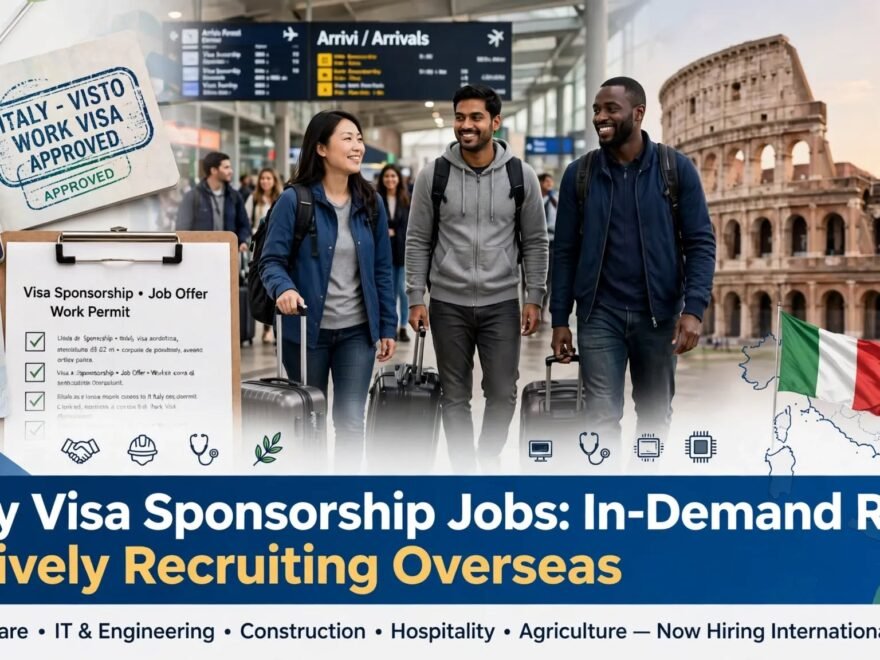
Italy continues to be a premier destination for skilled professionals, tradespeople, and seasonal workers seeking career growth and a high quality of life in Europe. With an aging domestic workforce and rapidly expanding industrial, healthcare, and technology sectors, Italian employers are turning to international talent.
Through structured immigration channels like the Decreto Flussi annual work quota system and the EU Blue Card, thousands of non-EU citizens secure fully sponsored employment permits each year. This comprehensive guide covers the primary sectors actively recruiting foreign workers, salary benchmarks, legal requirements, and actionable steps to land a sponsored job in Italy.
Understanding Work Visa Sponsorship in Italy
Foreign nationals from non-EU/EEA countries must secure a formal job offer and visa sponsorship from an Italian employer before applying for a work visa.
Read Also: No Italian? No Problem: Top English-Speaking Jobs Hiring in Milan & Rome
[Italian Employer Offers Job] ➔ [Applies for Authorization (Nulla Osta)] ➔ [Foreign Candidate Granted Work Visa]
The Two Main Immigration Pathways
- Decreto Flussi (Quota System): An annual government decree setting specific quotas for seasonal and non-seasonal foreign workers across designated industries. Employers pre-fill applications and submit them during official “Click Days” to secure work clearances.
- EU Blue Card (Out-of-Quota): Designed for highly qualified professionals possessing university degrees or specialized certifications. This pathway operates outside the annual Decreto Flussi quota limits, allowing Italian companies to recruit top talent year-round.
Top In-Demand Sectors Recruiting Overseas Workers
According to national employment trends and sector-wise shortage reports, several key industries face significant labor gaps. Italian companies in these sectors are actively filing for foreign worker permits.
               +-------------------------------------------+
               |  Top Sectors Hiring Foreign Talent        |
               +-------------------------------------------+
                                     |
    +------------------+-------------+-------------+------------------+
    |                  |                           |                  |
[Healthcare]    [IT & Technology]            [Logistics & Trades]    [Hospitality]
 - Nurses        - Developers                 - Drivers               - Chefs
 - Caregivers    - Data Analysts              - Electricians          - Hotel Staff
 - Doctors       - Cloud Engineers            - Welders               - Managers
1. Healthcare and Social Care
Italy’s healthcare network is actively hiring medical staff to maintain service standards in both public and private institutions.
- In-Demand Roles: Registered Nurses, Caregivers (Badanti), Doctors, Physiotherapists.
- Requirements: Recognized nursing/medical degree, language proficiency (Italian B1/B2 level recommended), professional registration with Italian health authorities.
- Average Gross Monthly Salary: €2,000 – €3,800.
2. Information Technology & Engineering
Milan, Rome, and Turin host expanding technology ecosystems requiring specialized digital talent. Highly skilled roles often qualify for the expedited EU Blue Card route.
- In-Demand Roles: Software Developers, Cloud Architects, Cybersecurity Analysts, Data Scientists, Mechanical/Civil Engineers.
- Requirements: Bachelor’s degree in STEM, relevant technical experience, proficiency in English (Italian is advantageous).
- Average Gross Monthly Salary: €2,800 – €5,500.
3. Skilled Trades, Construction & Logistics
The manufacturing and infrastructure sectors face persistent labor shortages. Italian businesses frequently apply through the Decreto Flussi non-seasonal allocation to fill these critical vacancies.
- In-Demand Roles: Welders, Electricians, Plumbers, Heavy Truck Drivers, Warehouse Operators.
- Requirements: Vocational qualifications, relevant trade experience, valid driving license (for transport roles).
- Average Gross Monthly Salary: €1,600 – €3,200.
4. Hospitality, Tourism & Agriculture
As a global tourism leader, Italy requires seasonal and permanent hospitality staff. Additionally, its agricultural heartlands rely heavily on overseas workers during harvest seasons.
- In-Demand Roles: Executive Chefs, Hotel Receptionists, Housekeeping Staff, Farm Workers, Harvest Equipment Operators.
- Requirements: Prior hospitality or agricultural experience; basic Italian language skills (A2 level).
- Average Gross Monthly Salary: €1,200 – €2,500.
Sector Summary: Roles, Requirements, and Compensation
| Sector | High-Demand Roles | Typical Salary Range (€/Month) | Recommended Language Level | Primary Visa Pathway |
| Healthcare | Nurses, Caregivers, Doctors | €2,000 – €3,800 | Italian (B1–B2) | Article 27 / Decreto Flussi |
| IT & Software | Developers, Data Scientists | €3,000 – €5,500 | English (B2) / Italian (A2) | EU Blue Card |
| Engineering | Civil, Mechanical, Electrical | €2,800 – €5,000 | Italian (B1) / English | EU Blue Card / Decreto Flussi |
| Logistics & Trades | Truck Drivers, Welders, Electricians | €1,600 – €3,200 | Italian (A2–B1) | Decreto Flussi |
| Hospitality | Chefs, Receptionists, Cleaners | €1,500 – €2,500 | Italian (A2–B1) | Decreto Flussi (Seasonal/Non-seasonal) |
| Agriculture | Harvesters, Farm Machinery Operators | €1,200 – €1,800 | Basic Italian (A2) | Decreto Flussi (Seasonal) |
Step-by-Step Guide to Securing Visa Sponsorship in Italy
Applying for visa-sponsored employment in Italy involves coordinating between the employer, the Italian Ministry of Interior, and local consular services.
1.Search & Secure a Job Offer:Focus on platforms with international recruiting history.
Apply for open positions using official job boards such as EURES Italy, ANPAL, LinkedIn, and Indeed Italy. Ensure your CV adheres to the Europass format and highlights trade certifications or degree equivalencies.
2.Employer Files for Work Authorization (Nulla Osta):Submitted via the Sportello Unico per l’Immigrazione (SUI).
Once an employment contract is signed, your Italian employer submits a visa sponsorship application through the Ministry of Interior’s SUI portal. The employer must prove that the wage meets National Collective Bargaining Agreements (CCNL) standards.
3.Issuance of the Clearance Certificate:Work authorization granted.
After background checks and verification of labor compliance, the SUI issues the official work authorization clearance—known as the Nulla Osta. This document is directly transmitted to the Italian consulate in your home country.
4.Apply for the Italian Work Visa:Consular appointment and document submission.
Schedule an appointment at the Italian Embassy or VFS Global visa center in your home country. Submit your valid passport, signed contract, application forms, and the issued Nulla Osta.
5.Arrival in Italy & Residence Permit (Permesso di Soggiorno):Mandatory administrative requirement within 8 days.
Upon entry into Italy, you must apply for a Permesso di Soggiorno per Motivi di Lavoro (Residence Permit for Work Purposes) at a local post office or Police Headquarters (Questura) within 8 working days.
Key Tips to Boost Your Job Application Success
- Format Your CV for the Italian Market: Use the Europass format. Translate key qualifications, certifications, and project achievements into Italian whenever possible.
- Learn Basic Italian: While tech companies in Milan or multinational firms in Rome operate in English, daily workplace communication and customer-facing roles in healthcare or hospitality strictly require Italian skills.
- Track Annual Decrees Early: Employers pre-fill Decreto Flussi applications well ahead of official “Click Days.” Building relationships with recruiters or applying to designated hiring agencies early improves submission timing.
- Verify Employer Credentials: Confirm that prospective employers are registered business entities in Italy capable of providing legitimate tax receipts (Visura Camerale) and meeting minimum CCNL salary obligations.
Conclusion & Frequently Asked Questions (FAQ)
Securing a visa-sponsored role in Italy requires understanding local labor demands and navigating structured immigration pathways. By targeting in-demand sectors like healthcare, software development, engineering, and logistics, non-EU candidates can establish long-term careers in southern Europe. Prepare your documents early, align your resume with European standards, and engage with verified recruitment platforms.
FAQ
Q1: What is the Decreto Flussi, and how does it affect foreign job seekers?
The Decreto Flussi is the Italian government’s annual decree that establishes quotas for how many non-EU citizens can enter the country for seasonal and non-seasonal work. Employers must apply during designated window periods (“Click Days”) to secure visa clearances for foreign hires.
Q2: Can I get a job in Italy if I don’t speak Italian?
Yes, particularly in multinational companies, tech startups, research institutions, and international schools where English is the primary language. However, learning basic to intermediate Italian significantly increases your employment opportunities in healthcare, trade, construction, and hospitality.
Q3: What is the EU Blue Card in Italy?
The EU Blue Card is a work permit tailored for highly skilled non-EU workers who have a higher education qualification (minimum 3-year university degree) or professional equivalent. It allows candidates to skip the Decreto Flussi quota restrictions and apply for visa sponsorship year-round.
Q4: Can my family join me in Italy on a work visa?
Yes. Foreign workers holding a valid residence permit (Permesso di Soggiorno) for work with a duration of at least one year can apply for family reunification (Ricongiungimento Familiare) for their spouse and dependent children.
One comment