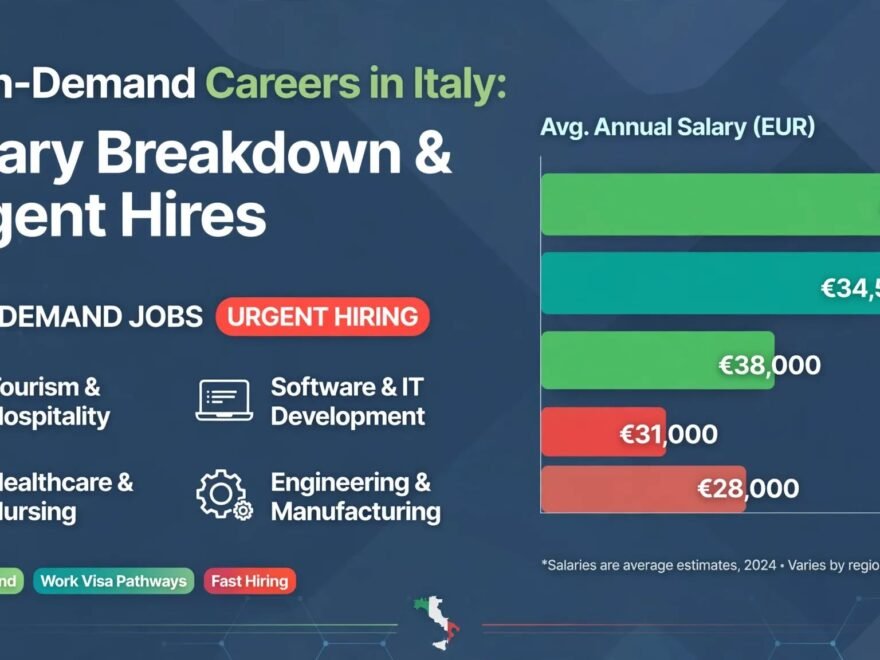
Italy is globally renowned for its rich history, cultural heritage, architecture, and high quality of life. Beyond its scenic landscapes, Italy boasts the third-largest economy in the Eurozone, offering robust opportunities for both local and international professionals.
In recent years, the Italian job market has undergone a significant transformation. Driven by rapid technological modernization, green energy initiatives under the EU’s recovery funds (PNRR), and an aging population, key sectors across the country are facing critical skill shortages. Italian employers actively seek qualified international talent to fill urgent vacancies in technology, healthcare, renewable energy, engineering, and seasonal services.
This comprehensive guide breaks down the most in-demand careers in Italy, salary structures across industries, key geographic job hubs, and practical steps to secure an Italian work permit.
Current State of the Italian Job Market
The Italian employment landscape is a dynamic blend of traditional manufacturing excellence and modern technological advancements. Historically dominated by small and medium-sized enterprises (SMEs) alongside luxury fashion, automotive, and food industries, the market is now expanding rapidly into digital services and sustainable tech.
Read Also: How to Find a Job in Italy in 2026: Essential Platforms and Open Listings
Key Factors Driving Demand:
- Digital Transformation (PNRR Investment): Italy’s National Recovery and Resilience Plan has allocated over €40 billion toward digital modernization. This has triggered massive demand for software developers, network architects, and cybersecurity specialists.
- Demographic Shifts: Italy has one of the world’s oldest populations. The growing demand for medical practitioners, nurses, and care assistants continues to outpace local supply.
- Industrial & Green Transition: High demand for mechanical engineers, automation experts, and photovoltaic/renewable energy installation technicians across industrial hubs.
                     +---------------------------------------+
                     |    Italian Job Market Drivers         |
                     +---------------------------------------+
                                         |
         +-------------------------------+-------------------------------+
         |                               |                               |
  Digitalization                 Demographic Shifts             Industrial & Green
(PNRR €40B Allocation)        (Aging Population Demand)            Transition
  • Cloud Architects           • Medical Doctors               • Renewable Energy
  • Software Engineers         • Nurses & Care Assistants      • Industrial Engineers
  • Cybersecurity              • Physical Therapists           • Automation Techs
Top In-Demand Sectors & Urgent Hires in Italy
If you are looking to build a career or relocate to Italy, targeting sectors experiencing severe labor shortages offers the fastest route to employment and work permit sponsorship.
1. Technology & Digital Services
The Italian tech sector, primarily centered around Milan and Rome, is experiencing an unprecedented shortage of qualified IT professionals. Many multinational tech companies and fast-growing Italian startups operate using English, making this sector particularly accessible to international talent.
Urgent Hires in Tech:
- Software Developers & Full-Stack Engineers: High demand for expertise in Python, Java, JavaScript, Cloud Architecture, and Microservices.
- Cybersecurity Specialists: Security analysts and cloud security consultants are needed to protect critical infrastructure and financial institutions.
- Data Engineers & AI Analysts: Companies require skilled talent to implement automated industrial models and business analytics tools.
2. Healthcare & Medical Services
Healthcare remains one of Italy’s most urgent hiring priorities. The national healthcare system (Servizio Sanitario Nazionale – SSN) and private healthcare networks face structural personnel deficits.
Urgent Hires in Healthcare:
- Registered Nurses (Infermieri): Crucial shortages exist across regional hospitals, residential care institutions, and private clinics.
- Specialist Physicians & Surgeons: Cardiologists, anesthesiologists, and general practitioners are urgently sought.
- Healthcare & Care Assistants (OSS / Badanti): Essential support roles for home care and elderly care facilities.
Note: Healthcare professionals trained outside the European Union must go through qualification recognition with the Italian Ministry of Health (Ministero della Salute) and demonstrate Italian language proficiency.
3. Engineering & Advanced Manufacturing
The northern Italian industrial belt—stretching across Lombardy, Piedmont, and Emilia-Romagna—is famous for precision manufacturing, automotive design, robotics, and food processing.
Urgent Hires in Engineering:
- Mechanical & Industrial Engineers: Specialized roles in machine design, plant management, and quality control.
- Automation & Robotics Specialists: Mechatronics engineers capable of designing and maintaining smart factory infrastructure.
- CNC Machine Operators & Maintenance Technicians: High demand for skilled blue-collar technicians across production facilities.
4. Renewable Energy & Sustainability
Aligned with the European Green Deal, Italy is investing heavily in solar power, wind energy, and energy-efficient building infrastructure.
Urgent Hires in Green Energy:
- Photovoltaic (PV) & Solar Installation Technicians: High field demand for technicians capable of setting up and servicing industrial solar installations.
- Energy Efficiency Engineers: Professionals who audit energy consumption and design eco-friendly industrial thermal renovations.
5. Tourism, Hospitality & Culinary Arts
Welcoming over 60 million international visitors annually, tourism is a major pillar of Italy’s national economy.
Urgent Hires in Tourism & Hospitality:
- Hotel Managers & Front Office Receptionists: Multi-lingual professionals are heavily favored in major tourist destinations.
- Head Chefs, Sous Chefs & Culinary Staff: Strong ongoing hiring across luxury resorts, fine dining establishments, and cruise lines.
Comprehensive Salary Breakdown in Italy
Salaries in Italy vary based on region, industry, experience, and qualification levels. Northern regions like Lombardy (Milan) and Piedmont (Turin) generally offer higher gross compensation compared to southern provinces, reflecting regional cost-of-living differences.
The standard gross national average annual salary in Italy is approximately €28,000 to €32,000. Below is a detailed salary breakdown across key sectors:
| Career / Role Category | Level / Experience | Average Gross Annual Salary (EUR) | Primary Job Locations |
| Software Developer | Mid – Senior Level | €35,000 – €65,000+ | Milan, Rome, Turin, Remote |
| Cybersecurity Specialist | Specialist / Lead | €40,000 – €70,000 | Milan, Rome |
| Specialist Physician | Senior Professional | €50,000 – €120,000+ | Nationwide |
| Registered Nurse (Infermiere) | Mid Level | €26,000 – €38,000 | Nationwide |
| Mechanical Engineer | Mid – Senior Level | €32,000 – €55,000 | Turin, Bologna, Milan |
| Renewable Energy Technician | Skilled Trade | €26,000 – €38,000 | Central & Southern Italy |
| Sales / Account Manager | Mid Level | €28,000 – €48,000 (+ Commission) | Milan, Rome |
| Hotel Receptionist / Front Desk | Entry – Mid Level | €20,000 – €30,000 | Rome, Venice, Florence, Milan |
Tax Incentives for Foreign Workers (Regime Impatriati)
One major advantage for foreign professionals moving to Italy is the attractive tax relief scheme known as the Lavoratori Impatriati Regime.
- Tax Exemption: Qualified foreign professionals and returning residents who relocate their tax residence to Italy can enjoy a 50% to 70% exemption on their taxable income for up to five years.
- Impact: This tax break significantly boosts net take-home pay, making Italian salary packages far more competitive relative to broader European standards.
Work Visas & Legal Pathways for International Job Seekers
To work legally in Italy as a non-EU citizen, you must possess a valid work visa and residency permit. The legal entry pathways are structured as follows:
1.Secure a Job Offer from an Italian Employer:Prerequisite for all work permit pathways.
An international applicant must first obtain a binding employment contract or job offer from a registered business operating in Italy.
2.Employer Files for Work Authorization (Nulla Osta):Submitted locally in Italy.
The Italian employer submits an application for work authorization (Nulla Osta) at the local Immigration Office (Sportello Unico per l’Immigrazione). This application operates under either the annual quota system (Decreto Flussi) or high-skill non-quota entries.
3.Apply for Long-Stay Work Visa (Type D):At the Italian Embassy/Consulate.
Once the Nulla Osta permit is granted, the applicant submits their official visa documentation to the Italian Embassy or Consulate in their home country.
4.Travel & Apply for Residence Permit (Permesso di Soggiorno):Within 8 days of arrival in Italy.
Upon entering Italy, the worker must visit the local police headquarters (Questura) within eight days to apply for their official Residence Permit (Permesso di Soggiorno).
Key Work Permit Categories:
- EU Blue Card: Designed for highly qualified non-EU professionals holding a recognized higher education degree and a valid higher-salary job offer. This visa bypasses standard quota restrictions.
- Decreto Flussi Quota Work Visa: Annual quotas released by the Italian government for seasonal and non-seasonal salaried employment across specific sectors like agriculture, construction, transport, and hospitality.
- Digital Nomad Visa: Allows highly skilled remote freelancers and tech workers to reside legally in Italy while working for clients or companies based outside the country.
Key Geographic Job Hubs in Italy
Where you look for employment in Italy determines both salary potential and industry exposure:
- Milan (Lombardy): The financial, commercial, design, and tech capital of Italy. Offers the highest concentration of corporate headquarters and multinational tech jobs.
- Rome (Lazio): The political and administrative center. Major hub for public administration, telecom, international non-profits, and tourism services.
- Turin (Piedmont): Italy’s primary automotive, aerospace, and industrial innovation center.
- Bologna (Emilia-Romagna): Renowned for industrial automation, advanced machinery, food manufacturing, and academic research.
How to Stand Out in the Italian Job Market
To successfully land an urgent hire role in Italy as an international candidate, keep these practical tips in mind:
- Learn Conversational Italian: While English is widely accepted in tech, finance, and international corporate offices in Milan, knowing Italian (B1/B2 level) dramatically increases your employment opportunities in healthcare, engineering, and client-facing roles.
- Tailor Your Resume (Europass Format): Many Italian companies prefer the standardized Europass CV format or clean, structured single-page resumes that clearly state work authorization status.
- Target Foreign-Friendly Job Portals: Utilize platforms like LinkedIn, Indeed Italia, InfoJobs, and the official EURES European Job Mobility Portal.
- Ensure Qualification Recognition: If you work in a regulated profession (such as medicine, nursing, architecture, or teaching), initiate degree validation (Dichiarazione di Valore) early.
Conclusion & Frequently Asked Questions
Italy presents an incredible opportunity for foreign professionals seeking career growth in Europe. While navigating job permit bureaucracy requires planning, high labor demand in technology, engineering, healthcare, and renewable energy opens real doors for skilled international workers. By aligning your skillset with Italy’s primary shortage occupations and taking advantage of tax incentives like the Regime Impatriati, you can build a successful and rewarding career in Italy.
Frequently Asked Questions (FAQs)
Q1: Can I work in Italy without speaking Italian?
A: Yes, especially in sectors like software development, cybersecurity, multinational corporate consulting, and international business based in Milan or Rome. However, learning functional Italian is highly recommended for long-term career growth, daily life, and regulated roles like healthcare.
Q2: Which jobs are easiest to secure visa sponsorship for in Italy?
A: Careers with critical shortages offer the clearest sponsorship pathways. Software engineers, senior healthcare professionals, mechanical engineers, and high-skilled industrial technicians frequently receive employer visa assistance.
Q3: What is the average cost of living compared to salaries in Italy?
A: While salaries in Italy are moderate compared to northern EU countries, the overall cost of living outside major metro areas (like central Milan or Rome) is noticeably lower. Additionally, special tax exemptions for relocating expats help maximize take-home income.
Q4: What is the EU Blue Card requirement for Italy?
A: To qualify for an EU Blue Card in Italy, you generally need a recognized university degree (minimum 3 years), a binding employment contract for a high-skilled role, and a salary offer that meets national threshold criteria.
One comment