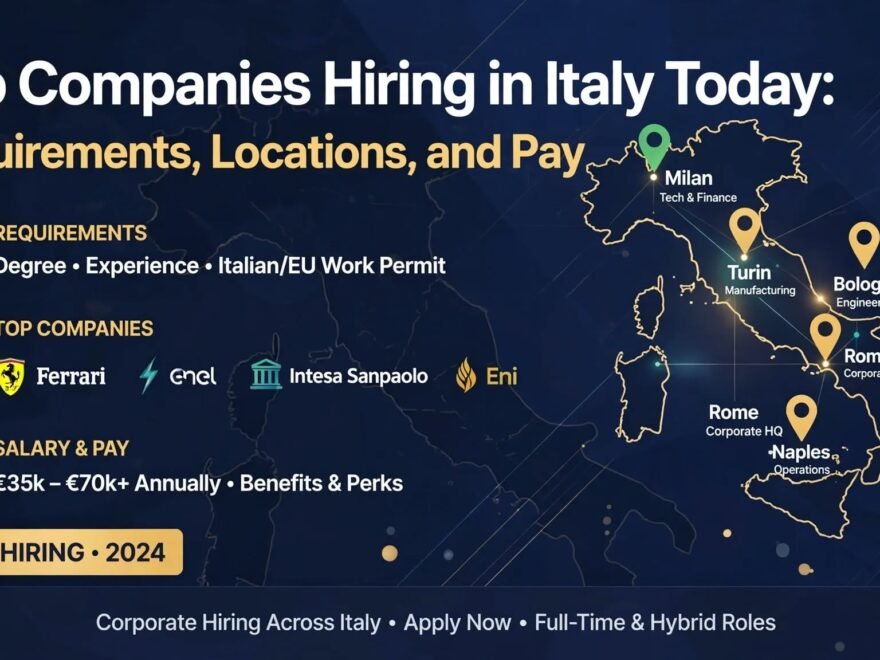
Italy is widely celebrated for its rich history, iconic art, and unmatched culinary tradition. However, beyond its cultural allure, the country boasts a robust, evolving industrial economy that serves as a cornerstone of the European market. From financial giants and luxury fashion houses in the north to booming renewable energy ventures and tech hubs across the nation, Italian enterprises are actively seeking top-tier domestic and international talent.
Whether you are an experienced tech specialist, a skilled engineer, or a corporate professional looking for your next career move, understanding the dynamic Italian hiring market is essential. This complete guide explores the top companies hiring in Italy today, detailing job requirements, key office locations, salary expectations, and practical tips for securing a work visa.
1. Overview of the Italian Job Market
The economic landscape of Italy is traditionally divided into two distinct economic zones:
- Northern Italy: The industrial and financial powerhouse of the country. Cities like Milan, Turin, and Bologna serve as hubs for banking, tech startups, automotive manufacturing, and high-end fashion.
- Central & Southern Italy: Known for government sector roles, agriculture, tourism, defense, and expanding renewable energy installations. Rome, as the national capital, hosts major corporate headquarters and international organizations.
Read Also: Jobs in Italy 2026: Salary Expectations, Requirements, and Open Roles
According to official economic reports, demand remains strong across tech, green energy, pharmaceuticals, construction, and specialized manufacturing sectors.
Average Annual Gross Salary (RAL) in Italy:
├─ Entry-Level Roles:     €24,000 – €32,000
├─ Mid-Level Professionals: €35,000 – €55,000
└─ Senior / Management:   €65,000 – €120,000+
2. Top Companies Hiring in Italy Today
Several major national corporations and global multinationals consistently drive hiring initiatives across Italy. Here are the key employers making significant talent investments:
A. Intesa Sanpaolo & Unicredit (Banking & Financial Services)
As Italy’s premier banking institutions, Intesa Sanpaolo and UniCredit lead the financial services sector. They frequently recruit for risk compliance, investment banking, software engineering, and corporate financial advisory.
- Key Locations: Milan, Turin, Rome
- In-Demand Roles: Compliance Officers, Financial Analysts, Data Engineers, Risk Managers
- Average Annual Salary: €40,000 – €95,000+
- Primary Requirements: Bachelor’s or Master’s degree in Finance, Economics, or Computer Science; fluency in Italian and professional working proficiency in English.
B. Enel Group (Energy & Utilities)
Enel is one of the world’s largest renewable energy operators and a major driver of Italy’s clean energy transition. The company frequently hires technical specialists to manage renewable power distribution and smart-grid infrastructure.
- Key Locations: Rome, Milan, Naples
- In-Demand Roles: Renewable Energy Engineers, Sustainability Analysts, Grid Operations Managers, Data Analysts
- Average Annual Salary: €38,000 – €75,000
- Primary Requirements: Background in Electrical, Environmental, or Industrial Engineering; familiarity with international ESG frameworks and energy software.
C. Stellantis & Ferrari (Automotive & Advanced Manufacturing)
Italy’s automotive legacy remains globally celebrated. Companies like Stellantis (owner of Fiat, Alfa Romeo, and Lancia) and Ferrari actively recruit engineers and software developers for electric vehicles (EVs) and autonomous driving systems.
- Key Locations: Turin, Maranello, Modena
- In-Demand Roles: Embedded Software Engineers, Mechanical Design Engineers, Battery Systems Specialists
- Average Annual Salary: €35,000 – €80,000
- Primary Requirements: STEM degree, proficiency with CAD/MATLAB, and practical experience in industrial manufacturing or vehicle dynamics.
D. Eni (Oil, Gas & Bio-Refining)
Eni is a global energy giant transitioning toward bio-refining, carbon capture, and geothermal energy development. It actively hires researchers, field technicians, and supply chain managers.
- Key Locations: San Donato Milanese (Milan), Rome
- In-Demand Roles: Chemical Engineers, Geoscientists, HSE (Health, Safety & Environment) Officers, Logistics Specialists
- Average Annual Salary: €42,000 – €88,000
- Primary Requirements: Degree in Chemical Engineering, Geology, or Logistics; willingness to work on international or offshore assignments.
E. Luxury & Fashion Conglomerates (Kering, LVMH Italia, Prada Group, Armani)
Milan stands as one of the world’s fashion capitals. Major luxury brands and holding groups offer high-value careers in design, digital marketing, supply chain management, and retail operations.
- Key Locations: Milan, Florence, Venice
- In-Demand Roles: E-Commerce Managers, Global Supply Chain Planners, Brand Strategists, Luxury Retail Directors
- Average Annual Salary: €36,000 – €90,000
- Primary Requirements: Degree in Fashion Management, Business Administration, or Marketing; multilingual capabilities (English, Italian, and French or Mandarin are major advantages).
F. Tech & Consulting Giants (Amazon, Accenture, EY, Deloitte)
International technology and professional services firms maintain substantial footprints in Italy, driving digital transformation projects for government and corporate clients alike.
- Key Locations: Milan, Rome, Bologna, Padua
- In-Demand Roles: Cloud Architects, Cybersecurity Consultants, SAP/ERP Specialists, Tech Risk Auditors
- Average Annual Salary: €32,000 – €70,000
- Primary Requirements: Strong technical skill set (Python, Java, AWS/Azure), consulting mindset, and adaptability to agile client environments.
3. Major Employment Hubs in Italy
| City | Primary Industries | Living & Working Environment | Average Salary Scale |
| Milan (Lombardy) | Finance, Tech, Fashion, Consulting, Media | Fast-paced, highly international, highest cost of living | High (€38,000 – €95,000+) |
| Rome (Lazio) | Government, Energy, Telecommunications, Tourism | Historic, corporate, expanding tech hubs | Moderate-High (€34,000 – €75,000) |
| Turin (Piedmont) | Automotive, Aerospace, Industrial Design | Engineering-focused, affordable cost of living | Moderate (€32,000 – €68,000) |
| Bologna (Emilia-Romagna) | Machinery, Automotive (Motor Valley), Food Tech | High quality of life, strong university network | Moderate (€30,000 – €65,000) |
4. Key Job Requirements for Working in Italy
To successfully land a role with a top company in Italy, candidates must meet specific technical, legal, and linguistic criteria:
A. Educational & Technical Qualifications
- Academic Background: Most professional roles require at least a Bachelor’s degree (Laurea) or a Master’s degree (Laurea Magistrale), particularly in fields such as engineering, finance, or computer science.
- Domain Expertise: Proficiency in specialized software tools (e.g., Python, SAP, CAD, Salesforce) and relevant professional certifications significantly boost hiring prospects.
B. Language Proficiency
- Italian Language: While multinational corporations and tech startups in Milan use English as their working language, operational fluency in Italian (B2/C1 level) remains a significant advantage for daily collaboration and career advancement.
- English Language: High proficiency in English is essential for cross-border operations, executive communication, and international client management.
C. Legal Requirements & Work Visas (For Non-EU Citizens)
International workers from non-EU countries require proper work authorization:
- EU Blue Card: Designed for highly qualified non-EU professionals holding a university degree or recognized higher professional qualifications. Offers a streamlined path to residency.
- Decreto Flussi (Quota System): The Italian government releases annual work visa quotas for specific economic sectors.
- Nulla Osta (Work Permit Authorization): Secured directly by the hiring employer from the local Italian immigration office (Sportello Unico per l’Immigrazione).
- Digital Nomad Visa: A dedicated pathway for remote professionals and freelancers earning income from foreign-registered entities.
5. Pay Structure and Compensation Packages in Italy
Understanding your compensation structure in Italy requires familiarity with standard local employment concepts:
- RAL (Retribuzione Annua Lorda): This is the gross annual salary specified in your employment contract.
- 13th and 14th Month Pay (Tredicesima & Quattordicesima): Italian contracts often divide annual salary into 13 or 14 installments, paying extra bonuses in December (Christmas) and June (Summer).
- CCNL (Contratto Collettivo Nazionale di Lavoro): Collective bargaining agreements that set minimum wage tiers, overtime rules, and notice periods across specific industries (e.g., Metalworking, Commerce, Banking).
- TFR (Trattamento di Fine Rapporto): Mandatory severance payout accumulated annually by the employer and paid out upon termination or retirement.
Conclusion
Italy presents dynamic career paths for skilled professionals who combine technical expertise, language flexibility, and cultural adaptability. From the corporate centers of Milan to the industrial zones of Turin and Emilia-Romagna, leading employers are actively competing for top talent. By tailoring your resume to local expectations, understanding visa regulations, and targeting in-demand industries, you can secure a rewarding position in one of Europe’s most vibrant job markets.
Frequently Asked Questions (FAQ)
Q1: Is it hard for non-EU citizens to get a job in Italy?
While hiring non-EU workers requires navigating visa quotas (Decreto Flussi) and obtaining a Nulla Osta, highly skilled professionals applying for roles eligible under the EU Blue Card program face a much smoother and faster process.
Q2: Can I work in Italy without speaking Italian?
Yes, especially in international tech companies, financial firms, consultancy groups, and research institutes located in Milan or Rome. However, learning functional Italian (B1/B2 level) will greatly improve your long-term integration and career growth.
Q3: What is a competitive salary in Italy?
A annual gross salary (RAL) between €35,000 and €55,000 is considered comfortable for mid-level professionals in most Italian cities. Specialized tech and management roles often exceed €70,000 to €100,000+ annually.
Q4: Which Italian job portals are best for finding open positions?
The most effective job search platforms in Italy include LinkedIn, Indeed Italia, InfoJobs.it, Euraxess (for academic and research roles), and official corporate career portals.
One comment