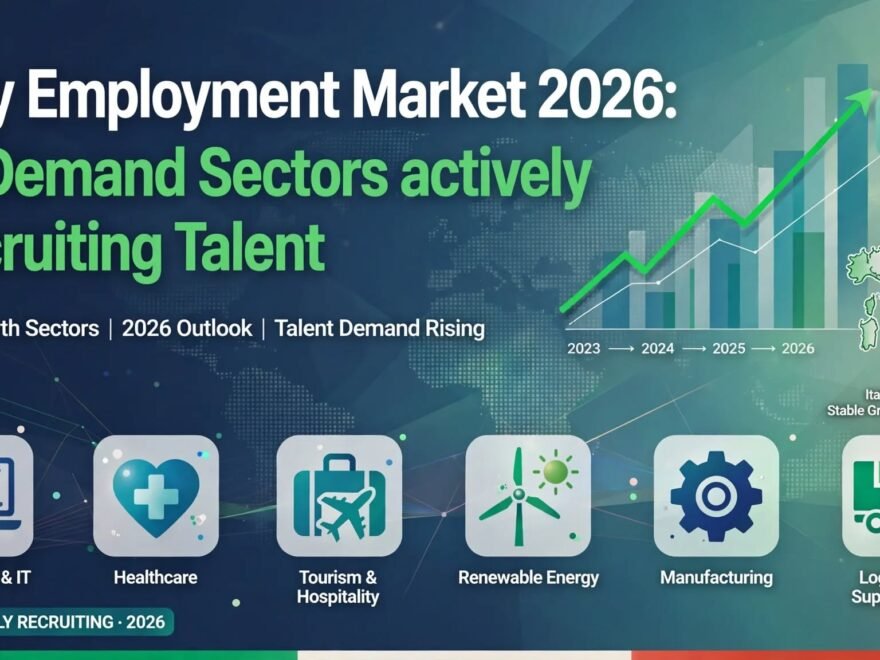
The Italian economy is undergoing a structural shift. Fueled by the National Recovery and Resilience Plan (PNRR) investments, green transition mandates, and a rapidly aging demographic, Italy is facing a major skilled labor shortage across key industries.
For global professionals, job seekers, and expatriates, the Italy Employment Market 2026 offers unprecedented opportunities. The Italian government has expanded work permit quotas under the multi-year Decreto Flussi framework (issuing over 164,000 work visas in 2026 alone) while streamlining pathways like the EU Blue Card to attract qualified international talent.
This comprehensive guide analyzes the top recruiting sectors, in-demand roles, salary trends, regional hiring dynamics, and visa pathways in Italy for 2026.
1. Key Macro Economic Trends Shaping Italy’s Job Market
Several economic drivers are creating urgent hiring demands across the Italian peninsula:
- Historic Low Unemployment Rates: Italy’s national unemployment rate has dropped to around 5.1%. While this reflects a healthy economy, it has created a tight labor market where open positions remain unfilled for months.
- The Shift Toward Permanent Contracts: Employers in Italy are moving away from temporary or fixed-term contracts. Companies are prioritizing long-term talent retention, making permanent (tempo indeterminato) hires the preferred norm.
- Demographic Realities: An aging workforce has triggered severe shortages in critical sectors like healthcare, manufacturing, and technical trades.
Read Also: Looking to Work in Europe? Explore Italy’s Top Job Vacancies Right Now
- PNRR & Green/Digital Investments: Billions of euros in European Union funding are driving rapid digitisation and infrastructure modernization, boosting demand for IT, civil engineering, and clean energy expertise.
2. In-Demand Sectors Actively Recruiting in Italy (2026)
                     ┌────────────────────────────────────────┐
                     │    TOP HIRING SECTORS IN ITALY 2026    │
                     └───────────────────┬────────────────────┘
                                         │
     ┌──────────────────┬────────────────┼────────────────┬──────────────────┐
     │                  │                │                │                  │
┌────▼────────┐  ┌──────▼───────┐  ┌─────▼────────┐  ┌───▼───────────┐  ┌─────▼────────┐
│ Technology  │  │ Engineering  │  │ Healthcare   │  │ Green Energy  │  │ Tourism &    │
│ & Digital   │  │ & Advanced   │  │ & Care       │  │ & Renewables  │  │ Hospitality  │
│             │  │ Manufacturing│  │ Services     │  │               │  │              │
└─────────────┘  └──────────────┘  └──────────────┘  └───────────────┘  └──────────────┘
A. Technology, Software & Digital Transformation
Technology is currently Italy’s fastest-growing employment domain. Driven by corporate modernization and cloud adoption, companies are heavily competing for tech professionals. In many multinational and startup environments, fluent English is often sufficient for technical roles.
- Most In-Demand Roles: Full-Stack Software Developers (Python, Java, JavaScript), Cybersecurity Specialists, Cloud Architects (AWS, Azure), Data Engineers, and AI / Machine Learning Engineers.
- Top Tech Hubs: Milan (the enterprise capital), Rome, and Turin.
- Average Salary Range: €32,000 to €65,000+ per year (depending on experience and specialization).
B. Engineering & Advanced Precision Manufacturing
As Europe’s second-largest manufacturing powerhouse behind Germany, Italy boasts world-class industrial sectors in mechanical engineering, automotive, robotics, and machine tools.
- Most In-Demand Roles: Mechanical Engineers, Automation & Robotics Technicians, Mechatronics Specialists, Industrial Designers, and CNC Machine Operators.
- Key Regions: Lombardy, Piedmont, Emilia-Romagna, and Veneto.
- Average Salary Range: €35,000 to €58,000 per year.
C. Healthcare, Pharmaceuticals & Personal Care
Italy’s aging population has led to a structural deficit in medical personnel. Both public healthcare (SSN) and private clinics are actively recruiting doctors, specialized nurses, and health assistance workers. Furthermore, Italy’s pharmaceutical and biotech clusters remain world leaders in production and research.
- Most In-Demand Roles: General Practitioners, Specialist Physicians, Registered Nurses, Physiotherapists, Biomedical Researchers, and Pharmacists.
- Requirements: EU qualification recognition or qualification validation through the Italian Ministry of Health (Ministero della Salute).
- Average Salary Range: €28,000 – €42,000 for nurses; €65,000 – €110,000+ for specialized physicians.
D. Green Transition, Renewable Energy & Sustainability
In line with European Green Deal targets, Italy is rapidly scaling up solar, wind, and energy-efficiency infrastructure. Energy transition specialists are among the most sought-after profiles.
- Most In-Demand Roles: Photovoltaic & Wind Installation Engineers, Energy Efficiency Consultants, Environmental Compliance Managers, and Sustainable Construction Engineers.
- Average Salary Range: €34,000 to €55,000 per year.
E. Tourism, Luxury Goods, & Hospitality
Tourism remains a pillar of Italy’s economy, contributing significantly to national GDP. With over 60 million global visitors annually, the sector recruits heavily year-round, with peak demand from spring through autumn.
- Most In-Demand Roles: Hotel General Managers, Multilingual Guest Relations Managers, Sommeliers, Executive Chefs, and E-commerce Managers for Luxury Fashion Houses.
- Key Skills: Multilingual communication (English, Italian, French, German, or Mandarin), digital booking management, and high-end client service.
3. High-Demand Roles vs. Skill Level Matrix
| Industry / Sector | Top In-Demand Roles | Key Required Skills | Preferred Qualifications |
| Information Technology | Cloud Engineer, AI Specialist, Cyber Risk Analyst | Python, AWS/Azure, Ethical Hacking, System Security | B.Sc./M.Sc. in Computer Science or Certifications |
| Manufacturing & Engineering | Robotics Engineer, Maintenance Technician, CAD Designer | PLC Programming, Automation, Mechatronics, Lean Manufacturing | Engineering Degree or Advanced Vocational Diploma |
| Healthcare | Specialized Nurse, Doctor, Medical Technician | Patient Care, Clinical Diagnostics, Telemedicine | Accredited Medical Degree + Ministry License |
| Renewable Energy | Energy Auditor, Solar Project Engineer | Photovoltaic System Design, Carbon Accounting | B.Sc. in Electrical/Environmental Engineering |
| Logistics & Supply Chain | Supply Chain Manager, Warehouse Systems Analyst | ERP (SAP), Logistics Optimization, Data Analytics | Bachelor’s in Logistics, Business, or Industrial Engineering |
4. Regional Job Market Breakdown: North vs. South Italy
Italy’s job market varies considerably depending on the geographical region:
- Northern Italy (Milan, Turin, Bologna, Verona): The industrial and financial powerhouse of the country. Offers the highest concentration of corporate headquarters, tech hubs, engineering facilities, and higher salary benchmarks.
- Central Italy (Rome, Florence): Rome leads in public administration, aerospace, telecommunications, international organizations, and AI strategy research. Florence and Tuscany focus heavily on luxury craft, pharmaceuticals, and tourism.
- Southern Italy & Islands (Naples, Bari, Palermo): Traditionally tourist and agriculture-driven, the South is experiencing growth in green energy projects, logistics, and regional digital innovation centers supported by government development funds.
5. Work Visas and Relocation Pathways for Non-EU Professionals
Navigating Italian work authorization is crucial for non-EU applicants seeking employment. The two main pathways include:
1. Decreto Flussi (Quota System)
The Italian government’s Decreto Flussi sets annual quotas for foreign workers.
- 2026 Quota Allocation: Over 164,000 work permits are allocated for non-EU nationals in 2026.
- Targeted Sectors: Construction, agriculture, healthcare, transport, and seasonal tourism.
2. EU Blue Card (Fast-Track for Highly Qualified Workers)
For highly skilled professionals, the EU Blue Card offers a quota-free pathway that can be processed year-round.
- Key Requirements: A higher education degree (or equivalent professional experience), a binding job offer from an Italian employer lasting at least 6 months, and a minimum gross annual salary threshold (approx. €38,000/year in 2026).
6. Practical Tips to Land a Job in Italy in 2026
To stand out to Italian recruiters and HR teams:
- Format Your CV into European Standard: Use the Europass format or a clean, modern single-column resume format that clearly highlights hard technical skills and qualifications.
- Learn Italian (at least B1/B2 level): While English is widely used in tech, finance, and international firms, conversational Italian is essential for everyday office integration, local clients, and government interactions.
- Leverage Job Portals: Regularly search popular platforms such as LinkedIn Italy, Indeed Italia, InfoJobs.it, and Monster.it.
- Network directly in Tech & Industry Hubs: Engage with industry meetups in Milan, Rome, or Turin, and connect directly with talent acquisition managers on LinkedIn.
Conclusion
The Italy Employment Market 2026 presents robust prospects for both domestic and foreign talent. Driven by technological modernization, green energy initiatives, and persistent skilled labor shortages, sectors like IT, advanced engineering, healthcare, and renewable energy are recruiting aggressively. By aligning your skill set with these high-growth sectors and utilizing streamlined immigration pathways like the EU Blue Card or Decreto Flussi quotas, securing a rewarding career in Italy is more achievable than ever.
Frequently Asked Questions (FAQs)
Q1: Can I work in Italy without speaking Italian?
Yes, especially in international companies, tech startups, IT development roles, and research institutions in cities like Milan and Rome where English is the primary working language. However, learning basic-to-intermediate Italian significantly improves your long-term career progression and social integration.
Q2: What is the average salary in Italy in 2026?
The average gross annual salary in Italy ranges between €32,000 and €45,000 depending on the industry, experience, and region. Skilled technical professionals and management roles often earn higher compensation.
Q3: What is the fastest way for non-EU professionals to get a work visa for Italy?
The EU Blue Card is generally the fastest route for highly skilled workers holding a university degree and a job offer meeting the annual salary benchmark. It is exempt from the strict annual quota caps imposed by the standard Decreto Flussi.
Q4: Which cities in Italy have the most job openings?
Milan leads in technology, finance, luxury goods, and corporate services. Turin and Bologna excel in engineering, automotive, and manufacturing, while Rome offers opportunities in public policy, IT, AI, and aerospace.
One comment