Canada has a large agricultural industry that produces fruits, vegetables, grains, dairy products, meat, and other essential food supplies. Farms, greenhouses, orchards, and agricultural businesses need workers throughout the year, although demand varies by region, season, and type of farming.
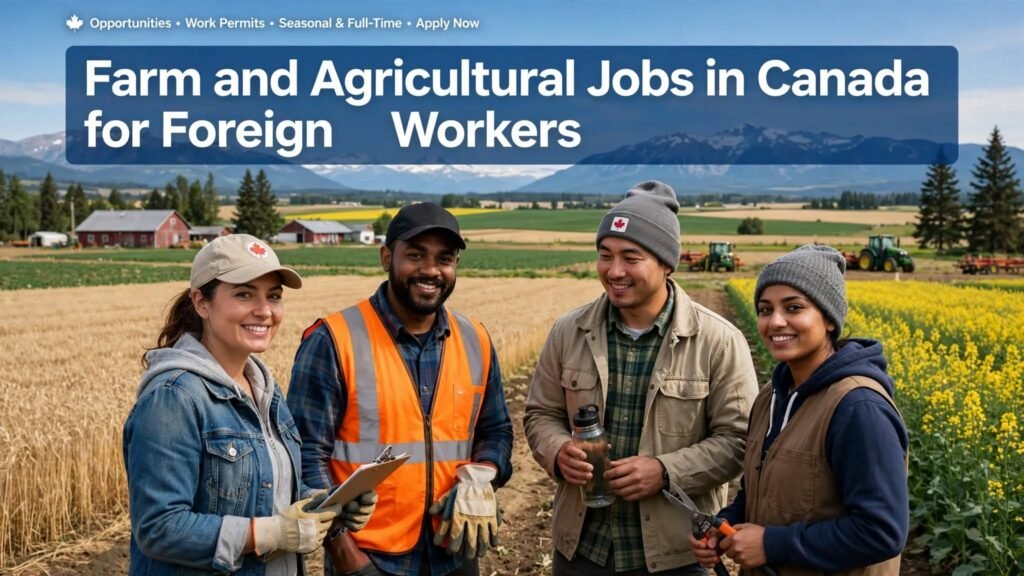
For international job seekers, farm and agricultural jobs in Canada for foreign workers can provide an opportunity to gain international work experience and earn an income while working in agriculture. Available positions may include fruit pickers, vegetable harvesters, greenhouse workers, dairy farm assistants, livestock handlers, and general farm labourers.
However, finding a job in Canada requires more than submitting an application online. Foreign workers must understand employer requirements, recruitment procedures, wages, and Canadian immigration rules before accepting an offer.
This guide explains the main agricultural job opportunities, expected earnings, qualifications, work permit options, and practical steps for applying safely in 2026.
Why Consider Agricultural Jobs in Canada?
Agriculture is an important part of Canada’s economy. Different provinces grow different crops and support various livestock and food production operations. This creates a range of employment opportunities for people with different levels of experience.
Read More: Construction Jobs in Canada: High-Paying Roles and How to Apply
Some agricultural positions require previous farming experience, while others provide on-the-job training.
Common reasons international applicants consider agricultural employment include:
- Entry-level opportunities: Some general farm labourer positions do not require formal qualifications.
- Seasonal employment: Fruit harvesting, vegetable picking, and crop packing create temporary work opportunities.
- Year-round positions: Certain dairy farms, livestock operations, and greenhouses operate throughout the year.
- Practical experience: Workers can develop skills in crop production, animal care, machinery operation, and food handling.
- Different work environments: Applicants can explore employment in orchards, commercial farms, greenhouses, and agricultural processing operations.
Job availability is not guaranteed. Employers recruit according to their actual staffing needs, and international applicants must meet the requirements of the relevant job and immigration program.
Types of Farm and Agricultural Jobs in Canada
Foreign workers can explore several categories of agricultural employment. The duties, working conditions, and experience requirements differ from one position to another.
1. Fruit Picking and Harvesting Jobs
Fruit harvesting is a common seasonal activity in Canadian agriculture. Orchards and berry farms may recruit additional workers when crops are ready for harvesting.
Typical duties include:
- Picking apples, berries, cherries, and other fruits.
- Sorting harvested produce according to quality.
- Placing fruit into containers or crates.
- Removing damaged produce.
- Keeping harvesting areas clean and organized.
These jobs may involve repetitive movements, standing for long periods, and outdoor work in changing weather conditions. Some employers train new workers, while others prefer candidates with harvesting experience.
2. Vegetable Farm Worker Jobs
Vegetable farms produce crops such as potatoes, carrots, onions, tomatoes, peppers, and leafy vegetables. Workers help with planting, maintaining, harvesting, and preparing crops for delivery.
Responsibilities may include watering plants, removing weeds, harvesting vegetables, sorting produce, and cleaning agricultural equipment.
The work can be physically demanding, particularly during busy planting and harvesting periods.
3. Greenhouse Worker Jobs
Greenhouses allow growers to cultivate plants in controlled environments. They may produce vegetables, flowers, seedlings, and ornamental plants.
Greenhouse workers can be responsible for:
- Planting seeds and transplanting seedlings.
- Watering plants and monitoring growth.
- Pruning and supporting crops.
- Packing vegetables and flowers.
- Maintaining clean growing areas.
- Following instructions related to plant health and pest control.
Some greenhouse positions offer more consistent schedules than seasonal outdoor farm work, but this depends on the employer and production cycle.
4. Dairy Farm Worker Jobs
Dairy farms need workers to help care for cattle and maintain milk production operations. Some positions are available throughout the year because dairy farming requires regular daily attention.
Common duties include feeding animals, cleaning stalls, monitoring livestock health, maintaining equipment, and assisting with milking procedures.
Applicants should be comfortable working around large animals and following strict hygiene and safety procedures. Previous livestock experience can be an advantage.
5. Livestock and Poultry Farm Jobs
Livestock farms may raise cattle, pigs, sheep, chickens, or other animals. Workers help maintain animal welfare, feeding routines, and clean housing conditions.
Depending on the position, duties may involve preparing feed, checking water supplies, cleaning animal areas, collecting eggs, and reporting signs of illness or injury.
Employers may provide training for entry-level duties, but specialized roles can require relevant experience.
6. Farm Machinery Operator Jobs
Agricultural machinery operators use tractors, harvesters, loaders, and other equipment to support farming operations.
These positions may offer higher earnings than some entry-level jobs because they require technical skills and experience.
Employers may expect candidates to demonstrate safe machinery operation, understand maintenance procedures, and hold any required licence or certification.
7. Agricultural Packing and Sorting Jobs
Packing and sorting workers help prepare farm products for storage, transportation, or sale. These positions may be based on farms, in packing facilities, or at agricultural processing businesses.
Typical tasks include checking product quality, grading produce, weighing items, filling boxes, labeling packages, and maintaining cleanliness.
Although some positions are less physically demanding than field harvesting, workers may still need to stand for extended periods or lift containers.
Farm Worker Salary in Canada
Agricultural wages vary according to the province, employer, occupation, experience, season, and employment arrangement. There is no single salary that applies to every farm worker in Canada.
The following table provides illustrative planning estimates, not verified current job offers or official wage averages. Actual pay should be confirmed through a current job advertisement and the applicable provincial or federal employment rules.
| Job position | Illustrative hourly pay (CAD) |
|---|---|
| General farm labourer | $16–$22 |
| Fruit picker or harvester | $16–$23 |
| Greenhouse worker | $16–$23 |
| Vegetable farm worker | $16–$22 |
| Dairy farm assistant | $17–$25 |
| Livestock farm worker | $16–$24 |
| Agricultural packing worker | $16–$22 |
| Experienced machinery operator | $20–$30 |
These ranges are intended for general budgeting and may not reflect current wages in a particular location. Some roles pay by the hour, while others may use piece-rate compensation where legally permitted.
How Much Can a Farm Worker Earn Monthly?
For example, a worker earning CAD $18 per hour and working 40 paid hours per week would have an approximate gross monthly income of:
CAD $18 × 40 hours × 52 weeks ÷ 12 = CAD $3,120
This is income before income tax, payroll deductions, and other applicable expenses. Actual earnings may be lower if work is seasonal, shifts are reduced, or unpaid hours occur.
Applicants should check whether the employment agreement guarantees a specific number of hours and whether overtime, holiday pay, accommodation, meals, or transportation are included.
Which Canadian Provinces Offer Agricultural Employment?
Agricultural opportunities exist across Canada, but the types of jobs available depend on the local industry and season.
Ontario
Ontario has fruit and vegetable farms, greenhouse operations, dairy farms, and agricultural packing facilities. Applicants may find opportunities in crop production and greenhouse work, depending on current vacancies.
British Columbia
British Columbia has fruit orchards, berry farms, vineyards, and greenhouse operations. Seasonal harvesting can create additional demand during particular parts of the year.
Alberta
Alberta supports livestock farming, grain production, dairy operations, and other agricultural businesses. Some employers seek workers with experience in animal care or machinery operation.
Saskatchewan
Saskatchewan is known for grain and oilseed production, as well as livestock farming. Machinery experience may be useful for certain agricultural positions.
Manitoba
Manitoba has crop farms, livestock operations, and agricultural businesses that support food production and processing.
Quebec
Quebec has dairy farms, orchards, vegetable growers, and greenhouse operations. Depending on the employer and location, French-language ability may be useful or required.
Applicants should search by province and occupation rather than assuming every region has the same vacancies or hiring requirements.
Can Foreign Workers Get Farm Jobs in Canada With Visa Sponsorship?
Foreign workers may be eligible for Canadian agricultural employment through specific immigration and temporary foreign worker programs. However, a job offer does not automatically guarantee a work permit or visa approval.
One important route is Canada’s Temporary Foreign Worker Program (TFWP). Eligible agricultural employers may hire foreign nationals when they meet the program’s requirements, including obtaining a Labour Market Impact Assessment (LMIA) where required.
The Seasonal Agricultural Worker Program (SAWP) is another route, but it is limited to eligible workers from participating countries and requires qualifying employer arrangements. It is not an open program for every nationality.
Other agricultural positions may fall under different work permit arrangements, depending on the occupation, employer, and current immigration rules.
What Is an LMIA?
A Labour Market Impact Assessment is a document that an employer may need before hiring a foreign worker through certain Canadian temporary work programs. It assesses the proposed hiring arrangement and its effect on Canada’s labour market.
More Jobs: General Farm Worker Jobs In Canada
An LMIA is not the same as a work permit. When an LMIA is required and approved, the foreign worker generally still needs to apply for the appropriate work authorization and satisfy the applicable immigration requirements.
Some jobs or programs may be exempt from the LMIA requirement, so applicants should verify the specific pathway rather than assuming every agricultural position follows the same process.
Important Documents for Applicants
Depending on the job and immigration pathway, candidates may need:
- A valid passport.
- A genuine written job offer or employment contract.
- An employer-specific work permit application, where applicable.
- An approved LMIA or relevant LMIA exemption documentation, if required.
- Evidence of relevant work experience or qualifications, when requested.
- Medical examination or police documentation, if applicable.
- Additional documents requested by Canadian immigration authorities.
Requirements can change, so always consult official Government of Canada immigration information before paying fees or submitting an application.
Requirements for Farm Jobs in Canada
Requirements vary by position. Entry-level crop harvesting may have fewer experience requirements than machinery operation or livestock management.
Common expectations include:
- Minimum working age: Applicants must meet applicable employment and immigration age requirements.
- Physical fitness: Some jobs involve lifting, bending, walking, standing, and outdoor work.
- Basic communication: Understanding workplace instructions is important for safety. English or French requirements depend on the role.
- Relevant experience: Previous farm work may improve an applicant’s chances for specialized positions.
- Safety awareness: Workers must follow equipment, chemical-handling, hygiene, and workplace safety instructions.
- Legal work authorization: Foreign nationals must obtain the appropriate authorization before starting work unless a lawful exemption applies.
Applicants should be honest about their qualifications. Do not claim to hold licences, certificates, or work experience that you cannot demonstrate.
How to Apply for Farm and Agricultural Jobs in Canada
A careful job search can help international applicants identify genuine vacancies and avoid recruitment scams.
Step 1: Prepare a Canadian-Style Resume
Create a clear resume that highlights your work experience, practical skills, education, and relevant training.
Include details such as:
- Previous farming or agricultural employment.
- Experience with harvesting, planting, packing, or livestock.
- Machinery operation skills, if relevant.
- Availability for seasonal or full-time work.
- Languages spoken and relevant certificates.
Keep the resume accurate and easy to read.
Step 2: Search for Current Vacancies
Use reliable job-search platforms and employer websites. Canada’s official Job Bank is a useful starting point.
Search for terms such as:
- Farm worker.
- General farm labourer.
- Fruit picker.
- Greenhouse labourer.
- Dairy farm worker.
- Agricultural equipment operator.
- Farm supervisor.
Filter results by location, wage, job type, and employer requirements. Read each advertisement carefully to determine whether the employer is willing and legally able to hire foreign workers.
Step 3: Check the Employer
Before sending personal documents, confirm that the business exists and that the advertised vacancy is genuine.
Look for the employer’s official website, business contact details, job description, workplace location, and written employment conditions.
Be cautious if an advertisement promises guaranteed visa approval, unusually high wages for simple work, or immediate travel without proper documentation.
Step 4: Submit Your Application
Follow the employer’s stated application procedure. Send your resume and any requested supporting documents through the official recruitment channel.
If you receive an offer, review the job title, wage, work location, hours, accommodation arrangements, deductions, and contract duration before accepting it.
Step 5: Verify the Work Permit Process
Ask the employer which immigration program applies to the position and whether an LMIA is required.
Check the relevant requirements directly through Immigration, Refugees and Citizenship Canada (IRCC) and other official Canadian government resources. Apply for the appropriate work permit when eligible and provide truthful information.
Step 6: Wait for the Required Authorization
Do not travel to Canada expecting to start employment merely because an employer has sent an offer letter.
Follow the official instructions for your application and wait until you have the required authorization to work. Processing times and approval decisions depend on individual circumstances and current immigration procedures.
How to Avoid Canadian Farm Job Scams
International job seekers can be targeted by people advertising fake agricultural vacancies. Some scammers copy the names and logos of genuine employers to make fraudulent offers appear convincing.
Protect yourself by following these precautions:
- Never assume a job offer is genuine simply because it appears on social media.
- Be suspicious of anyone guaranteeing a visa or work permit.
- Do not pay a recruiter who promises a guaranteed job without proper verification.
- Verify the employer’s identity using independent contact information.
- Read the employment contract before agreeing to its terms.
- Check official rules concerning recruitment fees and worker-paid expenses.
- Never provide false documents or make false statements in an immigration application.
Canadian rules governing recruitment fees differ according to the applicable program and jurisdiction. In particular, workers recruited under certain temporary foreign worker arrangements have protections against employers recovering prohibited recruitment fees. Verify the rules relevant to your circumstances.
Benefits and Challenges of Agricultural Work
Agricultural employment can provide valuable experience, but it is important to understand both the advantages and the demands.
Potential Benefits
- Opportunities to gain Canadian work experience.
- Practical training in agriculture and food production.
- Possible seasonal or year-round employment, depending on the role.
- Experience working with modern farming systems.
- Potential to develop transferable skills for future agricultural positions.
Common Challenges
- Physically demanding duties.
- Long or irregular shifts during busy periods.
- Exposure to cold, heat, rain, or other weather conditions.
- Seasonal uncertainty and fluctuations in working hours.
- Accommodation and transportation costs in some locations.
- Immigration restrictions linked to particular work permits.
Before accepting an offer, calculate your expected income after deductions and living expenses. A higher hourly wage does not necessarily mean higher savings if housing and transportation are expensive.
Official Resources for Finding Agricultural Jobs
Use reliable sources to research vacancies and immigration requirements:
- Government of Canada Job Bank: https://www.jobbank.gc.ca/
- Immigration, Refugees and Citizenship Canada: https://www.canada.ca/en/immigration-refugees-citizenship.html
- Temporary Foreign Worker Program information: https://www.canada.ca/en/employment-social-development/services/foreign-workers.html
These resources can help you find job advertisements, understand employer responsibilities, and check the latest work authorization requirements.
Frequently Asked Questions (FAQ)
1. Can foreigners apply for farm jobs in Canada?
Yes. Foreign nationals may apply for agricultural jobs when employers are recruiting internationally and the applicants meet the job and immigration requirements. Eligibility depends on the position and the relevant work permit pathway.
2. Do Canadian farm jobs offer visa sponsorship?
Some employers hire foreign workers through authorized immigration programs. However, not every farm offers this option, and an employer’s willingness to hire internationally does not guarantee immigration approval.
3. What is the salary of a farm worker in Canada?
Pay varies by occupation, province, employer, experience, and season. Applicants should check current job advertisements and applicable wage rules rather than relying on a single nationwide salary figure.
4. Can I apply for a Canadian farm job without experience?
Some entry-level harvesting, packing, and general labour positions may accept applicants without previous agricultural experience. Specialized jobs usually require relevant skills or training.
5. Are Canadian farm jobs permanent or seasonal?
Both types exist. Fruit picking and crop harvesting are often seasonal, while some dairy farms, livestock operations, and greenhouses recruit workers throughout the year. The actual contract determines the employment period.
6. Is IELTS required for farm worker jobs in Canada?
An IELTS test is not a universal requirement for every agricultural job or work permit. Language requirements depend on the occupation, employer, and applicable immigration pathway. Applicants should verify the rules for their specific case.
7. Can a farm worker bring family members to Canada?
Family members’ eligibility depends on the worker’s immigration status, occupation, permit conditions, and current family immigration rules. Family members do not automatically receive permission to work or study simply because the principal applicant has a job offer.
8. Where can I find genuine Canadian farm job vacancies?
Start with the official Government of Canada Job Bank and verified employer websites. Check each vacancy’s application procedure and confirm whether international applicants are eligible before submitting documents.
Conclusion
Farm and agricultural jobs in Canada can offer foreign workers opportunities in fruit harvesting, vegetable production, greenhouses, dairy farming, livestock care, packing, and agricultural machinery operation.
The best approach is to identify suitable vacancies, prepare an honest resume, verify the employer, understand the offered wages and employment conditions, and confirm the correct immigration pathway before making travel arrangements.
Remember that job availability, salaries, and immigration rules can change. Use official Canadian government resources to verify current information, avoid anyone promising guaranteed visa approval, and never begin work without the required legal authorization.
With careful research and a realistic understanding of the process, international applicants can make better-informed decisions about pursuing agricultural employment in Canada.